Need
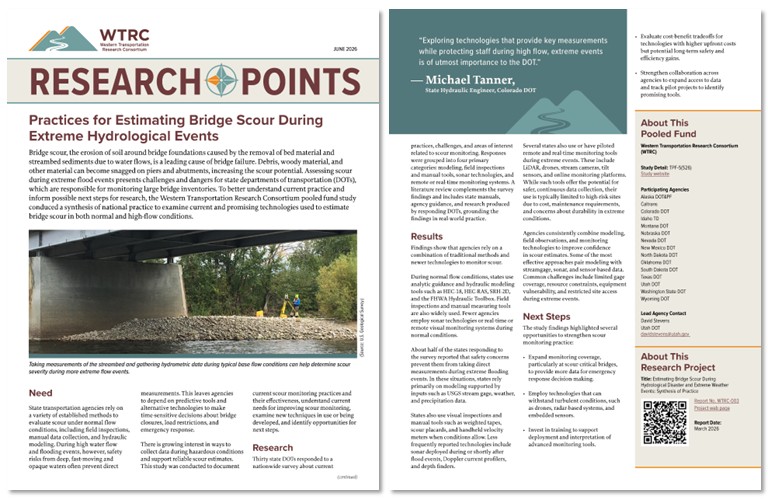
Bridge scour is a leading cause of bridge failure in the United States. While state DOTs have established methods for evaluating scour under normal flow conditions, assessing scour during hydrological disasters and extreme weather events remains a significant challenge.
High-flow turbulence, debris, and safety risks often prevent direct measurements, so instead agencies rely on predictive models in these circumstances. Yet the accuracy of these models depends on reliable data input, which can be difficult to obtain during extreme conditions.
Research
To address these challenges, WTRC initiated a research effort on this topic to explore established and emerging tools and technologies for estimating bridge scour in both normal and high-risk conditions. Technologies such as drones, sonar, LiDAR, and embedded sensors offer new opportunities to gather data in hazardous environments and improve the inputs used in hydraulic modeling.
Results
Thirty state DOTs responded to a survey to provide insight into the methods and technologies currently used to detect scour during normal flow conditions and during extreme hydrological events. Agencies also described the effectiveness of their approaches and the challenges they face with implementation.